

 Investment Team Voices Home Page
Global Markets: Fundamentals Have the Floor
July 1, 2026
Nick Niziolek, CFA, Dennis Cogan, CFA, Paul Ryndak, CFA, and Kyle Ruge, CFA
Summary Points:
- As active growth investors, we are excited to see markets rewarding earnings and fundamental growth characteristics.
- The combination of fundamentally driven markets and strong thematic tailwinds sets up well for our approach.
- While we are optimistic about the direction of the global economy and equity markets, the potential for rapid changes in macro conditions requires increased flexibility and balance across portfolios.
Global equity benchmarks soared during the quarter, led by the emerging markets. In both emerging and developed markets, growth benchmarks outperformed the still-strong returns of value.
Figure 1. Robust Gains Across Global Markets, Growth Leads the Way
Total Return %, 2Q 2026
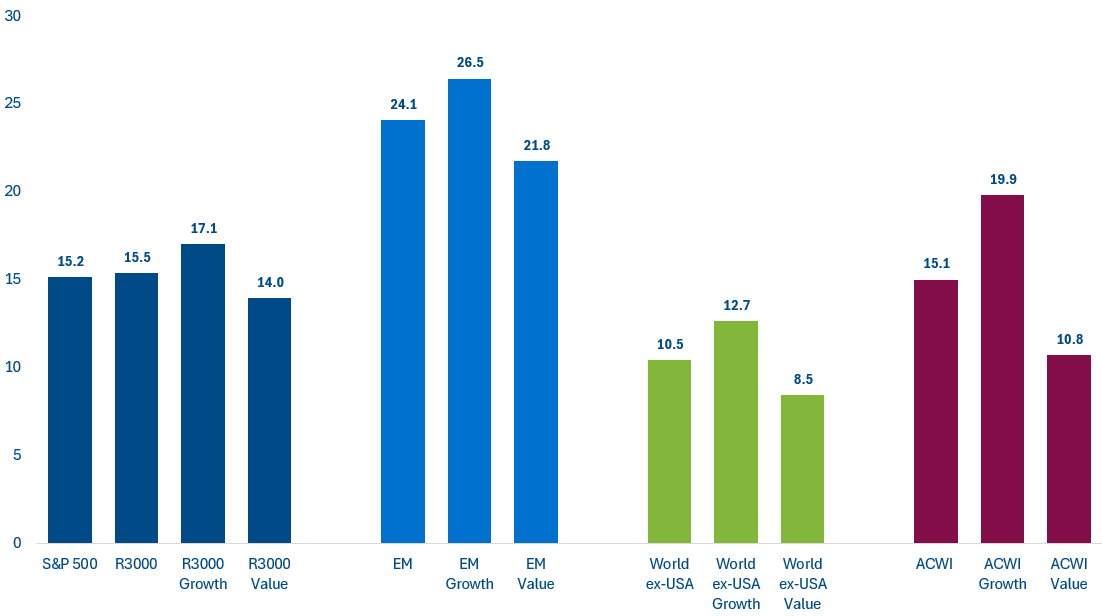
Past performance is no guarantee of future results. Source: Bloomberg. Indexes are unmanaged, do not include fees or expenses, and are not available for direct investment. EM, World ex USA, and ACWI are MSCI indexes; see definitions in endnotes.
The outperformance of the growth indexes reflects investors’ focus on fundamentals. As we discussed in our recent post, “Pole Position for a Market Powered by Earnings,” one reason we are feeling upbeat about global equities is that markets have been driven by earnings improvements and upward earnings revisions—not unsupported price momentum. In Figure 2, the dark blue bars show the performance of stocks that have the highest EPS momentum, while the light blue bars show the performance of the overall region. Over the past year, stocks with the highest EPS momentum have outperformed across regions.
Figure 2. Real Deal: Earnings Momentum Is Driving Global Markets
Stocks with Highest EPS Momentum versus Overall Market, one-year performance ending 6/30/2026
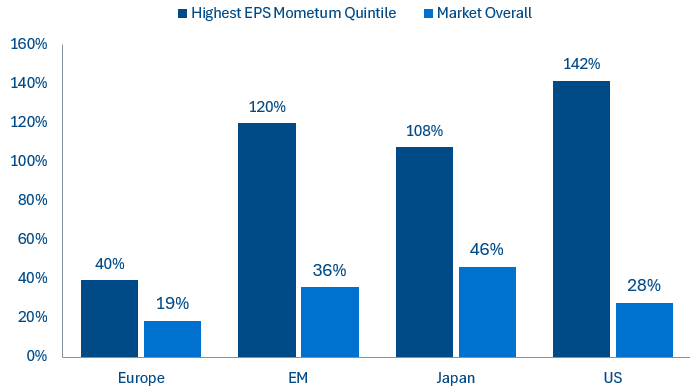
Past performance is no guarantee of future results. Source: Calamos Investments. Highest EPS Momentum Quintile: companies that rank in the top quintile based on their price/earnings ratio relative to expected earnings growth from the first forward fiscal year (F+1) to the second forward fiscal year (F+2)—that is, the percentage change from consensus EPS in the first forward year to EPS in the second.
Putting Our Eggs in More Than One Basket
Beneath the strong gains, there’s been a lot going on under the hood (e.g., shifting inflation and interest rate expectations, rising and falling levels of geopolitical tension). This is an environment that plays to our team’s strengths as active growth managers, and we have been proactive in adjusting the overall balance of our portfolios.
During the second quarter, this included increasing exposure to cyclical growth opportunities, such as banks and construction companies, and to opportunities in healthcare, a traditionally more defensive growth area. Overall, we maintain a bias toward secular growth and cyclical growth, with defensive growth names rounding out the portfolios.
Including quality names demonstrating fundamental momentum across the three cohorts gives us a fulcrum to pivot around as conditions evolve. We believe this approach will serve our funds well because many uncertainties could push global markets in different directions, especially in the short term. Lingering inflation leading to tighter monetary policy, a more opaque Federal Reserve, US midterms, and shifting conditions in the Middle East could all stoke volatility.
We continue to find many attractive growth companies tied to intelligent machines and AI infrastructure investment. As we discussed in our recent post, “The AI Capex Boom Has an International Address,” US hyperscalers may be dominating the headlines, but international companies are profiting from demand in areas like optical networking, chips, and power and electrical equipment.
In addition to intelligent machines and AI infrastructure investment, other key themes in our funds include emerging-market consumption and development, precision health and life-sciences innovations, and the energy transition and power infrastructure investment.
In Closing
We’re encouraged to see a market driven by growth fundamentals and believe each of our funds is well-positioned to benefit. Below, we’ve provided a snapshot of each fund, along with its Morningstar Rating, as a measure of risk-adjusted performance.
| Fund | Morningstar Overall Rating™ | Opportunity Set and Focus |
|---|---|---|
| Calamos Global Opportunities Fund (CGCIX) |
Morningstar Overall RatingTM Among 401 Global Moderate Allocation funds. The Fund's risk-adjusted returns based on load-waived Class I Shares had 5 stars for 3 years, 4 stars for 5 years and 5 stars for 10 years out of 401, 388 and 323 Global Moderate Allocation Funds, respectively, for the period ended 9/30/2026. |
|
| Calamos Global Equity Fund (CIGEX) |
Morningstar Overall RatingTM Among 286 Global Large-Stock Growth funds. The Fund's risk-adjusted returns based on load-waived Class I Shares had 4 stars for 3 years, 4 stars for 5 years and 5 stars for 10 years out of 286, 274 and 201 Global Large-Stock Growth Funds, respectively, for the period ended 9/30/2026. |
|
| Calamos Evolving World Growth Fund (CNWIX) |
|
|
| Calamos International Growth Fund (CIGIX) |
Morningstar Overall RatingTM Among 353 Foreign Large Growth funds. The Fund's risk-adjusted returns based on load-waived Class I Shares had 4 stars for 3 years, 3 stars for 5 years and 4 stars for 10 years out of 353, 333 and 222 Foreign Large Growth Funds, respectively, for the period ended 9/30/2026. |
|
| Calamos International Small Cap Growth Fund (CSGIX) |
Morningstar Overall RatingTM Among 106 Foreign Small/Mid Growth funds. The Fund's risk-adjusted returns based on load-waived Class I Shares had 4 stars for 3 years out of 106 Foreign Small/Mid Growth Funds, respectively, for the period ended 9/30/2026. |
|
Before investing, carefully consider the fund’s investment objectives, risks, charges and expenses. Please see the prospectus and summary prospectus containing this and other information which can be obtained by calling 1-866-363-9219. Read it carefully before investing.
*Indexes are unmanaged, do not include fees or expenses and are not available for direct investment. The MSCI Emerging Markets Index is a free-float-adjusted market capitalization index designed to measure equity market performance in emerging markets. The MSCI World ex USA Index measures the performance of developed equity markets, excluding the United States. The MSCI ACWI Index measures the performance of developed and emerging market equities. The MSCI World ex USA Growth Index, MSCI ACWI Growth Index, and the MSCI EM Growth Index include securities from these universes with growth characteristics; the MSCI World ex USA Value Index, MSCI ACWI Value Index, and MSCI EM Value Index include securities from these universes with value characteristics. The S&P 500 Index measures the performance of large-cap US equities. The Russell 3000 Index measures the performance of 3,000 publicly held US companies by total market capitalization, representing approximately 98% of the investable US equity market. The Russell 3000 Growth Index is representative of those Russell 3000 Index companies with higher price-to-book ratios and higher forecasted growth values. The Russell 3000 Value Index is representative of those Russell 3000 Index companies with lower price-to-book ratios and lower forecasted growth values. Opinions, estimates, forecasts, and statements of financial market trends that are based on current market conditions constitute our judgment and are subject to change without notice. The views and strategies described may not be appropriate for all investors. References to specific securities, asset classes and financial markets are for illustrative purposes only and are not intended to be, and should not be interpreted as, recommendations.
Important Risk Information. An investment in the Fund(s) is subject to risks, and you could lose money on your investment in the Fund(s). There can be no assurance that the Fund(s) will achieve its investment objective. Your investment in the Fund(s) is not a deposit in a bank and is not insured or guaranteed by the Federal Deposit Insurance Corporation (FDIC) or any other government agency. The risks associated with an investment in the Fund(s) can increase during times of significant market volatility. The Fund(s) also has specific principal risks, which are described below. More detailed information regarding these risks can be found in the Fund’s prospectus.
Foreign security risk: As a result of political or economic instability in foreign countries, there can be special risks associated with investing in foreign securities, including fluctuations in currency exchange rates, increased price volatility, and difficulty obtaining information. In addition, emerging markets may present additional risk due to the potential for greater economic and political instability in less developed countries.
The principal risks of investing in the Calamos International Small Cap Growth Fund include: equity securities risk consisting of market prices declining in general, growth stock risk consisting of potential increased volatility due to securities trading at higher multiples, foreign securities risk, emerging markets risk, small and mid-sized company risk, and portfolio selection risk. The Fund invests in small capitalization companies, which are often more volatile and less liquid than investments in larger companies.
The principal risks of investing in the Calamos Global Opportunities Fund include: convertible securities risk consisting of the potential for a decline in value during periods of rising interest rates and the risk of the borrower to miss payments, synthetic convertible instruments risk consisting of fluctuations inconsistent with a convertible security and the risk of components expiring worthless, foreign securities risk, emerging markets risk, equity securities risk, growth stock risk, interest rate risk, credit risk, high yield risk, forward foreign currency contract risk, portfolio selection risk, and liquidity risk.
The principal risks of investing in the Calamos Evolving World Growth Fund include equity securities risk consisting of market prices declining in general, growth stock risk consisting of potential increased volatility due to securities trading at higher multiples, foreign securities risk, emerging markets risk, convertible securities risk consisting of the potential for a decline in value during periods of rising interest rates and the risk of the borrower to miss payments, and portfolio selection risk.
The principal risks of investing in the Calamos Global Equity Fund include: equity securities risk consisting of market prices declining in general, growth stock risk consisting of potential increased volatility due to securities trading at higher multiples, value stock risk, foreign securities risk, forward foreign currency contract risk, emerging markets risk, small and mid-sized company risk, and portfolio selection risk.
The principal risks of investing in the Calamos International Growth Fund include: equity securities risk consisting of market prices generally declining, growth stock risk consisting of potential increased volatility due to securities trading at higher multiples, foreign securities risk, emerging markets risk, small and mid-sized company risk and portfolio selection risk.
Morningstar Ratings™ are based on risk-adjusted returns and are through 5/31/26 for the share class listed and will differ for other share classes. Morningstar ratings are based on a risk-adjusted return measure that accounts for variation in a fund's monthly historical performance (reflecting sales charges), placing more emphasis on downward variations and rewarding consistent performance. Within each asset class, the top 10%, the next 22.5%, 35%, 22.5%, and the bottom 10% receive 5, 4, 3, 2 or 1 star, respectively. Each fund is rated exclusively against US domiciled funds. The information contained herein is proprietary to Morningstar and/or its content providers; may not be copied or distributed; and is not warranted to be accurate, complete or timely. Neither Morningstar nor its content providers are responsible for any damages or losses arising from any use of this information. Source: ©2026 Morningstar, Inc.
026054k 0726