

 Investment Team Voices Home Page
Welcome to the Calamos Outlooks, October 2026
October 1, 2026
Introduction by John P. Calamos, Sr., Founder, Chairman and Global Chief Investment Officer
Rising oil prices, inflation worries, continued geopolitical concerns, tech stock selloffs, spiking Treasury yields, and the first Fed rate hike in more than three years made for a challenging quarter. On an asset-class level, shelter was hard to come by. However, for the year-to-date through September, global stock and convertible securities markets are still up nicely. Bond markets have faced stiffer headwinds, as anxiety about inflation and a more hawkish Fed has come into focus.
Global Asset Class Returns
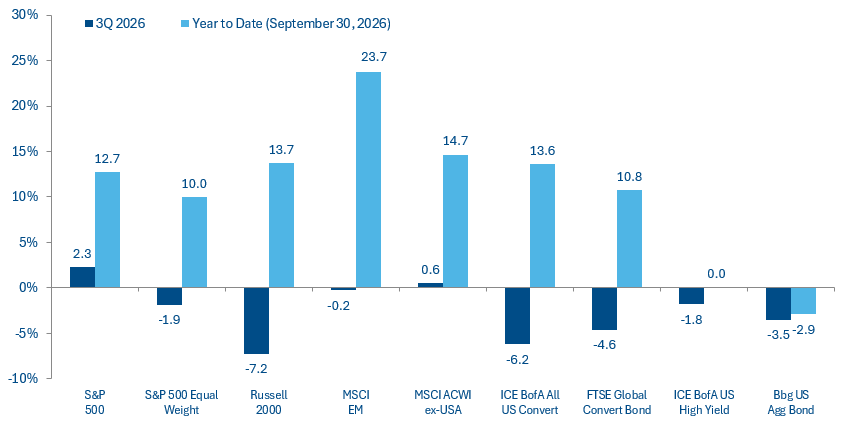
Past performance is no guarantee of future results. Source: Morningstar.
Many investors are likely to ask whether the coming months will be a continuation of the third quarter or a return to the optimism of earlier in the year. No one has a crystal ball, so I don’t think this is the right question. A better question to ask is how to position an asset allocation to navigate uncertainties. Fifty years in the markets has taught me that there’s opportunity in all markets—and as you’ll read in the commentaries linked below, our investment teams believe the same.
I’d encourage investors to be prepared for choppy markets ahead, especially because of the US midterm elections. Markets will be watching closely for changes in regulations and fiscal policy; both have significant implications for large and small businesses (e.g., policies that encourage job growth), which ripple across the economy to households and individuals.
I’m also confident we’re in an environment that calls for rigorous bottom-up security selection. One theme running through our teams’ commentaries is that market leadership is always rotating—today’s leaders won’t necessarily be the leaders of tomorrow. You can’t just invest in an asset class passively, or even a theme—you have to pick the right names in a theme. So, what matters most is using proprietary research and rigorous discipline to find opportunity.
It’s also good to separate media buzz and conventional wisdom from facts. For example, many people think that small-cap stocks struggle when the Federal Reserve raises rates. That’s not actually the case, as our Senior Portfolio Manager Brandon Nelson explains in “Navigating the Air Pockets in a Long-Term Uptrend.” In fact, we’re seeing a lot of tailwinds for smaller companies, and for Brandon’s approach. This is one of the reasons I’m very pleased to announce that we’ve grown our ETF suite with Calamos Timpani Active SMID Growth ETF, which we recently converted from our time-tested mutual fund.
It’s important to stay diversified and look beyond traditional asset classes and approaches. For example, income-oriented investors are in a tough spot right now if they are relying exclusively on bonds. However, as our Senior Portfolio Manager Jason Hill points out, rising rates are “just another day in the office” for Calamos Market Neutral Income Fund (CMNIX), which has withstood rate hikes thanks to an alternative strategy with little exposure to interest rate risk.
In an environment that’s likely to be choppy, I’m also bullish about actively managed convertible securities, either in dedicated portfolios, like our flagship Calamos Convertible Fund (CICVX) or our Calamos Convertible Equity Alternative ETF (CVRT), or as part of multi-asset-class approaches, like Calamos Growth and Income Fund (CGIIX). The convertible market has long been the choice of growth companies seeking capital and today offers compelling ways to participate in the most innovative names, including AI leaders, with less potential downside. (This is a theme that our Co-CIO Eli Pars writes about in “Taking Some Chips Off the Table Paid Off in 3Q.”) Record-breaking issuance—more than $200 billion year-to-date—gives our teams a good hunting ground for our selective approaches.
I hope you enjoy our teams’ insights below. And, as always, we thank you for your trust.
High Altitudes
Calamos Phineus Long/Short Fund (CPLIX)
Michael Grant
Rising Rates: Trouble for Bonds, Just Another Day in the Office for CMNIX
Calamos Market Neutral Income Fund (CMNIX)
Jason Hill
Hedging When the Price is Right
Calamos Hedged Equity Fund (CIHEX)
Jason Hill
Ascending the Wall of Worry with Confident Footing
Calamos Convertible Fund (CICVX)
Jon Vacko, CFA and Joe Wysocki, CFA
Taking Some Chips Off the Table Paid Off in 3Q
Calamos Global Convertible Fund (CXGCX)
Eli Pars, CFA
The Cycle Raises the Bar
Calamos Growth and Income Fund (CGIIX)
John Hillenbrand, CPA
How Much Longer Can the Good Times Roll
Calamos Growth Fund (CGRIX)
Matt Freund, CFA and Michael Kassab, CFA
Navigating the Air Pockets in a Long-Term Uptrend
Calamos Timpani Small Cap Growth Fund (CTSIX), Calamos Timpani Active SMID Growth ETF (CTAG)
Brandon Nelson, CFA
Global Markets: Same Engine, New Leaders
Calamos Global and International Suite
Nick Niziolek, CFA, Dennis Cogan, CFA, Paul Ryndak, CFA and Kyle Ruge, CFA
Committed to a Discipline, Not a Decision
Fixed Income Suite (CIHYX, CTRIX, CSTIX)
Matt Freund, CFA, Christian Brobst and Chuck Carmody, CFA
Before investing, carefully consider the fund’s investment objectives, risks, charges and expenses. Please see the prospectus and summary prospectus containing this and other information which can be obtained by calling 1-866-363-9219. Read it carefully before investing.
Source for convertible issuance data: BofA Global Research.
Diversification and asset allocation do not guarantee a profit or protect against a loss. Alternative strategies entail added risks and may not be appropriate for all investors. Indexes are unmanaged, are not available for direct investment, and do not include fees and expenses.
Opinions, estimates, forecasts, and statements of financial market trends that are based on current market conditions constitute our judgment and are subject to change without notice. The views and strategies described may not be appropriate for all investors. References to specific securities, asset classes, and financial markets are for illustrative purposes only and are not intended to be, and should not be interpreted as recommendations.
Indexes are unmanaged, do not include fees or expenses and are not available for direct investment. The S&P 500 Index is considered generally representative of the US equity market and is market cap weighted. The MSCI All Country World ex USA Index represents the performance of global equities, excluding the US. The MSCI Emerging Markets Index is a measure of the performance of emerging market equities. The ICE BofA US High Yield Index is an unmanaged index of US high yield debt securities. The ICE BofA All US Convertible Index (VXA0) is a measure of the US convertible market. The FTSE Global Convertible Bond Index measures the performance of the global convertible market. The Bloomberg US Aggregate Index is a broad-based benchmark of the US investment grade and global investment grade bond market. It includes Treasury, government related, corporate and securitized fixed-rate bonds. The Russell 2000 Index is a measure of US small cap performance. The Russell 3000 Index measures the performance of 3,000 publicly held US companies based on total market capitalization, which represents approximately 98% of the investable US equity market.
Important Risk Information. An investment in the Fund(s) is subject to risks, and you could lose money on your investment in the Fund(s). There can be no assurance that the Fund(s) will achieve its investment objective. Your investment in the Fund(s) is not a deposit in a bank and is not insured or guaranteed by the Federal Deposit Insurance Corporation (FDIC) or any other government agency. The risks associated with an investment in the Fund(s) can increase during times of significant market volatility. The Fund(s) also has specific principal risks, which are described below. More detailed information regarding these risks can be found in the Fund’s prospectus.
The principal risks of investing in the Calamos Market Neutral Income Fund include: equity securities risk consisting of market prices declining in general, convertible securities risk consisting of the potential for a decline in value during periods of rising interest rates and the risk of the borrower to miss payments, synthetic convertible instruments risk, convertible hedging risk, covered call writing risk, options risk, short sale risk, interest rate risk, credit risk, high yield risk, liquidity risk, portfolio selection risk, and portfolio turnover risk.
Foreign security risk. As a result of political or economic instability in foreign countries, there can be special risks associated with investing in foreign securities, including fluctuations in currency exchange rates, increased price volatility, and difficulty obtaining information. In addition, emerging markets may present additional risk due to the potential for greater economic and political instability in less-developed countries.
The principal risks of investing in the Calamos Convertible Fund include a potential decline in the value of convertible securities during periods of rising interest rates and the possibility that borrowers miss payments. The credit standing of the issuer and other factors may also affect a convertible security’s investment value. Synthetic convertible instruments may fluctuate and perform inconsistently with an actual convertible security, and components of a synthetic convertible can expire worthless. The Fund may also be subject to foreign securities risk, equity securities risk, credit risk, high-yield risk, portfolio selection risk and liquidity risk.
As a result of political or economic instability in foreign countries, there can be special risks associated with investing in foreign securities, including fluctuations in currency exchange rates, increased price volatility, and difficulty obtaining information. In addition, emerging markets may present additional risks due to the potential for greater economic and political instability in less-developed countries.
The principal risks of investing in the Calamos Growth and Income Fund include the potential for convertible securities to decline in value during periods of rising interest rates and the possibility of the borrower missing payments; synthetic convertible instruments risks include fluctuations inconsistent with a convertible security and components expiring worthless. Others include equity securities risk, growth stock risk, small and midsize company risk, interest rate risk, credit risk, liquidity risk, high-yield risk, forward foreign currency contract risk, and portfolio selection risk.
The principal risks of investing in the Calamos Timpani Active SMID Growth ETF include: American Depositary Receipts risk, authorized participant concentration risk, cash holdings risk, costs of buying and selling fund shares, currency risk, derivatives risk, equity securities risk, foreign securities risk, forward foreign currency contract risk, futures and forward contracts risk, growth stock risk, liquidity risk, market risk, portfolio selection risk, portfolio turnover risk, premium-discount risk, secondary market trading risk, sector risk, securities lending risk, small and mid-sized company stock risk, tax risk, and trading issues risk.
Equity Securities Risk: The securities markets are volatile, and the market prices of the Fund's securities may decline generally. The price of equity securities fluctuates based on changes in a company's financial condition and overall market and economic conditions. If the market prices of the securities owned by the Fund (i.e., the Fund's long position) fall, the value of your investment in the Fund will decline.
Small and Mid-Sized Company Stock Risk: Small- and mid-sized company stocks have historically been subject to greater investment risk than large-company stocks. The prices of small- to mid-sized company stocks tend to be more volatile and less liquid than large-company stocks. Small and mid-sized companies may have no or relatively short operating histories or may be newly formed public companies. Some of these companies have aggressive capital structures, including high debt levels, or are involved in rapidly growing or changing industries and/or new technologies, which pose additional risks.
026077k 1026