

 Investment Team Voices Home Page
Rising Rates: Trouble for Bonds, Just Another Day in the Office for CMNIX
October 1, 2026
Summary Points:
- Calamos Market Neutral Income Fund (CMNIX) is designed to be an all-weather fixed-income alternative, seeking to deliver consistent absolute returns with little exposure to interest rate risk.
- The benefit of our approach was clear over the quarter, as traditional bonds failed to deliver the steady performance conservative investors seek from high-quality fixed income. Broad bond market indexes declined for the quarter and year to date as the Federal Reserve resumed raising rates. CMNIX gained over both periods.
Fund Performance and Positioning
We believe the quarter demonstrates the value of our approach and CMNIX’s ability to deliver steady performance, regardless of the direction of interest rates. Bonds were battered by continued anxiety over inflation and oil prices, and fears of a more hawkish Warsh Fed—which proved to be correct as the Federal Reserve raised rates in September. As the 10-year yield spiked, bonds declined for the quarter, dragging year-to-date performance into the red as well. Meanwhile, CMNIX took the turmoil in stride and is now more than 700 basis points ahead of the US Aggregate Bond Index for the year to date.
Total Return (%) as of 9/30/26
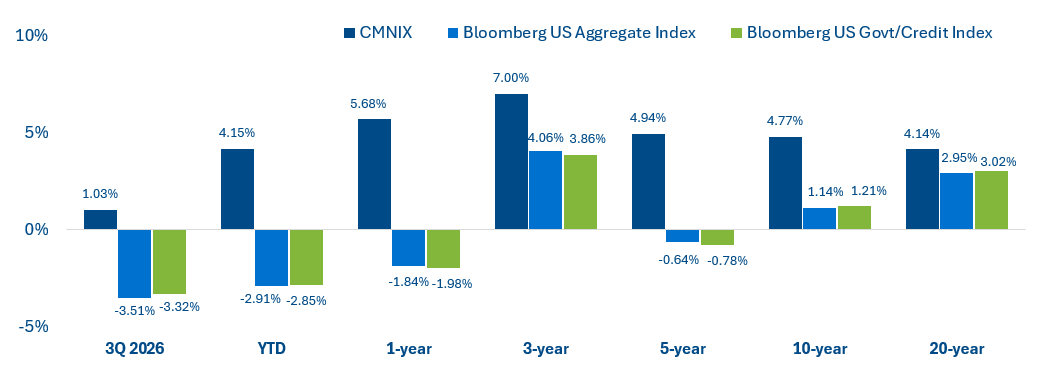
Data as of 9/30/2026. Source: Morningstar. Performance data quoted represents past performance, which is no guarantee of future results. Current performance may be lower or higher than the performance quoted. Please refer to Important Risk Information. The principal value and return of an investment will fluctuate so that your shares, when redeemed, may be worth more or less than their original cost. All performance shown assumes reinvestment of dividends and capital gains distributions. The fund’s gross expense ratio as of the prospectus dated 2/27/2026 is 1.01% for Class I shares. Returns of more than 12 months are annualized.
Average annual total return measures net investment income and capital gain or loss from portfolio investments as an annualized average.
From a strategy allocation standpoint, hedged equity remains the largest weighting, increasing by approximately two percentage points from the start of the third quarter, followed by convertible arbitrage, which declined by the same amount during the quarter. Merger arbitrage and SPAC arbitrage allocations remained in line for the quarter.
Calamos Market Neutral Income Fund Strategy Allocation
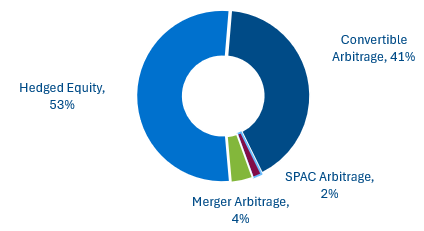
Data as of 9/30/26. The portfolio is actively managed, and holdings are subject to change.
Hedged Equity Strategy
Hedged equity was the largest contributor. Today's rate level, index volatility near year lows, and attractive skew let us use S&P 500 Index options to run a heavier-than-average hedge that pays us a net premium, whereas in other rate and volatility environments we would pay for a hedge this heavy. Higher rates make the calls we write more expensive and the puts we buy cheaper. Low volatility keeps those puts inexpensive, and skew lets us fund put spreads by selling puts further out of the money. During the quarter, we added put spreads across several expirations and rolled the core of our short call position out to year-end. We also traded around a small slice of that position in July, covering and reselling as the market moved.
Convertible Arbitrage Strategy
Convertible arbitrage was essentially flat for the quarter. US convertible issuance reached $36 billion in the quarter and $126 billion year to date, already surpassing last year's record of $119 billion and annualizing to approximately $168 billion. Rising rates are likely to help keep supply coming. Higher rates raise what straight debt costs an issuer, and a convertible lets a company pay a lower coupon, sometimes none, in exchange for giving the investor the opportunity to participate in equity upside through the convertible’s embedded option.
We continue to see opportunity in our arbitrage strategy, supported by an improving backdrop that emerged during the third quarter. Much of this year's record convertible issuance has come from the AI infrastructure stack, and for most of the year, investors paid up for upside volatility in those names. High realized volatility often results from credit stress, which erodes the bond leg of a hedged position. For most of this year it did not: the volatility in these names came largely to the upside, so the strategy captured gamma* without the credit damage that usually accompanies it. (For more on gamma capture, see our post, “Gamma Trading: Why Big Market Swings Can Be Good News”) In the third quarter, Treasury yields backed up sharply, high yield posted its weakest month in four years, and convertible spreads widened alongside. Existing paper traded lower even as new deals cleared, with the lowest-coupon, highest-premium bonds hit hardest. Investors have since pushed back in the primary market on zero-coupon structures, wide conversion premiums, and the volatility assumptions used to price longer-dated deals. The repricing was a cost to positions we already held but also restored forward return potential. Implied volatility in convertibles remains attractive relative to listed options, and we expect to buy better-priced paper than was available three months ago.
While we are constructive overall on convertible arbitrage, we are monitoring some potential headwinds. Fed officials have signaled another increase is possible this year, which would add pressure to traditional fixed income, and further widening in credit spreads would add to the pressure on existing convertibles. A sharp selloff in AI-related equities could close the window for new convertible issuance, and a further narrowing of the gap between convertible and listed volatility would reduce the cheapness we capture.
Merger Arbitrage and SPAC Arbitrage
Both strategies made positive contributions, and conditions are little changed from last quarter. In merger arbitrage, deal activity and financing remain healthy. New SPAC issuance continues to come to market, and SPAC arbitrage earns its carry on trust cash at short-term rates, which moved higher with the September Fed increase.
Outlook
We see a strong case for CMNIX from here. We don't position CMNIX on a call about market direction; rather our approach is to participate, manage risk, and adapt. For investors weighing what to do with a bond allocation while rates rise, we believe the fund consistently demonstrates its value as an alternative with little sensitivity to that risk. We see opportunities in convertible issuance, which we expect to stay strong as AI infrastructure companies fund their buildouts, and higher yields incentivize companies to issue convertibles instead of non-convertible debt. That said, issuers typically pause new deals ahead of earnings, and we expect the pause this October to give the secondary market time to absorb recent supply. On the hedged equity side of the book, we also see opportunities in a rate-and-vol environment that keeps paying us to hedge. Each of Calamos Market Neutral Income Fund’s strategies draws its return from multiple sources, and we believe that mix keeps the fund's results tied to our process and less dependent on the direction of rates.
Total Return (%) as of 9/30/26
| 3Q26 | YTD | 1 Year | 3 Year | 5 Year | 10 Year | |
|---|---|---|---|---|---|---|
| Calamos Market Neutral Income Fund (CMNIX) | 1.03% | 4.15% | 5.68% | 7.00% | 4.94% | 4.77% |
| Bloomberg US Govt/Credit Bond Index | -3.32% | -2.85% | -1.98% | 3.86% | -0.78% | 1.21% |
Source: Morningstar. Performance data quoted represents past performance, which is no guarantee of future results. Current performance may be lower or higher than the performance quoted. Please refer to Important Risk Information. The principal value and return of an investment will fluctuate so that your shares, when redeemed, may be worth more or less than their original cost. The fund’s gross expense ratio as of the prospectus dated 2/27/2026 is 1.01% for Class I Shares. You can obtain performance data current to the most recent month end by visiting https://www.calamos.com/funds/mutual/market-neutral-income-cmnix/#_performance.
Average annual returns measure net investment income and capital gain or loss from portfolio investments as an annualized average, assuming reinvestment of income and capital gain distributions. In calculating net investment income, all applicable fees and expenses are deducted from the returns. Calendar year returns measure net investment income and capital gain or loss from portfolio investments for each period specified. The fund also offers Class C shares, the performance of which may vary. Class I shares are offered primarily for direct investment by investors through certain tax-exempt retirement plans and by institutional clients, provided such plans or clients have assets of at least $1 million. For eligibility requirements and other available share classes see the prospectus and other Fund documents at www.calamos.com.
Before investing, carefully consider the fund’s investment objectives, risks, charges and expenses. Please see the prospectus and summary prospectus containing this and other information which can be obtained by calling 1-866-363-9219. Read it carefully before investing.
Diversification and asset allocation do not guarantee a profit or protect against a loss. Alternative strategies entail added risks and may not be appropriate for all investors.
*Gamma: How much the convertible value rises or falls for a given stock move is referred to as delta. The higher the delta, the higher the sensitivity to the stock’s moves. Gamma is the change in delta as a stock price moves.
Source for convertible issuance data: BofA Global Research.
Opinions, estimates, forecasts, and statements of financial market trends that are based on current market conditions constitute our judgment and are subject to change without notice. The views and strategies described may not be appropriate for all investors. References to specific securities, asset classes and financial markets are for illustrative purposes only and are not intended to be, and should not be interpreted as, recommendations.
Indexes are unmanaged, do not include fees or expenses, and are not available for direct investment. The Bloomberg US Aggregate Index measures the performance of investment-grade bonds. The Bloomberg US Government/Credit Bond Index includes Treasuries and agencies that represent the government portion of the index and includes publicly issued US corporate and foreign debentures and secured notes that meet specified maturity, liquidity, and quality requirements to represent credit interests.
Important Risk Information. An investment in the Fund(s) is subject to risks, and you could lose money on your investment in the Fund(s). There can be no assurance that the Fund(s) will achieve its investment objective. Your investment in the Fund(s) is not a deposit in a bank and is not insured or guaranteed by the Federal Deposit Insurance Corporation (FDIC) or any other government agency. The risks associated with an investment in the Fund(s) can increase during times of significant market volatility. The Fund(s) also has specific principal risks, which are described below. More detailed information regarding these risks can be found in the Fund’s prospectus.
The principal risks of investing in the Calamos Market Neutral Income Fund include: equity securities risk consisting of market prices declining in general, convertible securities risk consisting of the potential for a decline in value during periods of rising interest rates and the risk of the borrower to miss payments, synthetic convertible instruments risk, convertible hedging risk, covered call writing risk, options risk, short sale risk, interest rate risk, credit risk, high yield risk, liquidity risk, portfolio selection risk, and portfolio turnover risk.
Foreign security risk. As a result of political or economic instability in foreign countries, there can be special risks associated with investing in foreign securities, including fluctuations in currency exchange rates, increased price volatility, and difficulty obtaining information. In addition, emerging markets may present additional risk due to the potential for greater economic and political instability in less developed countries.
026077f 1026