

 Investment Team Voices Home Page
Taking Advantage of a Rare Opportunity in Hedged Equity
October 22, 2026
Dave O’Donohue, Co-Head of Alternative Strategies, Senior Co-Portfolio Manager
Summary Points
We believe:
- A flexible approach gives Calamos Hedged Equity Fund (CIHEX) and Calamos Active Hedged Equity ETF (CHDG) a real edge over systematic hedged equity strategies.
- We took advantage of an extraordinary opportunity this month—one that we haven’t seen in decades.
- CIHEX’s and CHDG’s hedges set up well for equity investors concerned about market risk.
We recently adjusted the hedge in CIHEX and CHDG. We believe our ability to jump on this unique opportunity is a powerful example of what our active hedged equity approach can do. Below, we walk through what we did, why we did it, and what we would expect along the way.
Q. What changed?
A. We rolled our existing hedge into a slightly different structure, using December 2028 expirations and strikes closer to the current spot price. Previously, we were selling about 35% in calls and buying about 65% in at-the-money puts. Now we are selling only approximately 28% in calls and were able to buy approximately 72% notional in puts. We also resized and reset each fund’s short put leg, rolling it out to December 2028 on about 32% of notional with a strike about 30% out of the money. This still leaves us with net puts of around 40%.
Q. Is it a material difference?
A. It is still the same core trade as our 65/35, so we do not see it as a material shift; however, it is change that we are excited about. The slightly different structure and the longer-dated expirations bring different benefits and risks, which we’ll explain below.
Q. Why now?
A. The 2-year Treasury yield rose from 3.47% to almost 5% this year, while longer-dated volatility stayed fairly low. Higher rates make the calls we sell more valuable and the puts we buy cheaper, and low volatility keeps the absolute cost of the puts lower. Together, those two things brought the price of this hedge to a level we have seen rarely, if ever, in the last 20 years (see the chart below). We see this as a unique opportunity to lock in a hedge with the kind of asymmetry that suits investors looking for equity upside with less potential downside.
A rare opportunity
Net cost of hedge structure, % of S&P 500 level
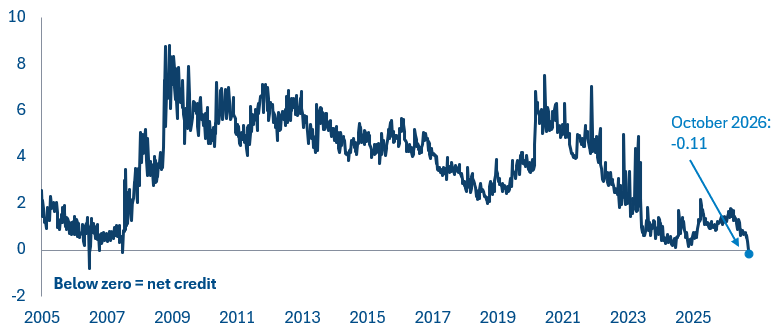
Source: Calamos and Bloomberg. Weekly data, January 2005 to October 9, 2026. Hypothetical pricing based on quoted S&P 500 option prices for the listed expiry nearest 26 months; not fund performance.
Q. What are the potential benefits?
A. We believe moving out to 2028 lets us improve on the 65/35 profile we had before. We think the new structure could capture 70% or more of the market's upside with 30% or less of its downside over the life of the hedge, through December 2028. Additionally, since we have put a profile we like in place for a longer period, it gives us maximum flexibility going forward. We can let an unusually attractive hedge run its course, but we can always adjust it further if an even better opportunity emerges.
One caveat: this 70/30 is a target for the full life of the structure. Along the way, the hedge is marked to market, so the options reflect the time remaining, volatility, and interest rates, in addition to the level of the S&P 500. If the options are held to expiration, their payoff at expiration supports the 70/30 target described above. In the short run, we would expect somewhat higher downside capture and lower upside capture than the target. Moving the hedge out to two years lengthens that early window, so results over shorter periods may look different from what we expect over the full life of the structure. This is typical of a longer-dated hedge, and in our view, strengthens the case for thinking of CIHEX and CHDG as strategies to use as part of a long-term allocation.
Q. Why short puts, too?
A. We continue to believe the short put leg makes sense, in some capacity, for two reasons. First, it gives us another way to benefit from our active approach. We do not have to sell the same amount as our long puts, and we do not have to sell them on the same day we buy the long puts, so we can use market moves and changes in volatility to adjust opportunistically. By selling puts during periods of stress or down markets and buying them back during periods of complacent or rising markets, we can generate realized profits and/or improve the funds’ return profiles over time. Second, because the short put is struck about 30% below the market, it makes the funds more long-leaning after a large selloff. We do not believe in systematically capping our put position, which leaves a large unhedged part of the downside distribution, but we do think hedged equity investors want to slowly increase participation after selloffs, and this structure gives us a way to do that.
Q. What does this new hedge mean for CIHEX and CHDG?
A. We believe this is a great example of why active hedged equity is the right route and that this is a particularly attractive time for these strategies. The market gives different things at different times, and right now it is offering an unusually good opportunity for asymmetry. For investors who are worried about the equity risk or where we are in the market cycle, we believe CIHEX and CHDG can make it easier to stay in equities but pull back a bit on downside risk exposure.
Before investing, carefully consider the fund’s investment objectives, risks, charges and expenses. Please see the prospectus and summary prospectus containing this and other information which can be obtained by calling 1-866-363-9219. Read it carefully before investing.
A put option is out of the money (OTM) when its strike price is below the current market price of the underlying asset.
An investment in the Fund is subject to risks, and you could lose money on your investment in the Fund. There can be no assurance that the Fund will achieve its investment objective. Your investment in the Fund is not a deposit in a bank and is not insured or guaranteed by the Federal Deposit Insurance Corporation (FDIC) or any other government agency. The risks associated with an investment in the Fund can increase during times of significant market volatility. The Fund also has specific principal risks, which are described below. More detailed information regarding these risks can be found in the Fund's prospectus.
The principal risks of investing in the Calamos Hedged Equity Fund include: covered call writing risk, options risk, equity securities risk, correlation risk, mid-sized company risk, interest rate risk, credit risk, liquidity risk, portfolio turnover risk, portfolio selection risk, foreign securities risk, American depositary receipts, and REITs risks.
Options Risk: The Fund's ability to close out its position as a purchaser or seller of an over-the-counter or exchange-listed put or call option is dependent, in part, upon the liquidity of the options market. There are significant differences between the securities and options markets that could result in an imperfect correlation among these markets, causing a given transaction not to achieve its objectives. The Fund's ability to utilize options successfully will depend on the ability of the Fund's investment adviser to predict pertinent market movements, which cannot be assured.
The principal risks of investing in the Calamos Active Hedged Equity ETF include: American depositary receipts risk, authorized participant concentration risk, cash holdings risk, costs of buying and selling fund shares, correlation risk, covered call writing risk, currency risk, debt securities risk, interest rate risk, credit risk, default risk, derivatives risk, equity securities risk, FLEX options risk, foreign securities risk, forward foreign currency contract risk, futures and forward contracts risk, liquidity risk, market maker risk, market risk, new fund risk, options risk, other investment companies risk, portfolio selection risk, portfolio turnover risk, premium-discount risk, secondary market trading risk, sector risk, tax risk, trading issues risk, uncovered call writing risk.
Other Investment Companies Risk: The Fund may invest in the securities of other investment companies to the extent that such investments are consistent with the Fund's investment objectives and permissible under the 1940 Act.
FLEX Options Risk: The Fund(s) will utilize FLEX Options issued and guaranteed for settlement by the Options Clearing Corporation (OCC). In the unlikely event that the OCC becomes insolvent or is otherwise unable to meet its settlement obligations, the Fund(s) could suffer significant losses. Additionally, FLEX Options may be less liquid than standard options. In a less liquid market for the FLEX Options, the Fund(s) may have difficulty closing out certain FLEX Options positions at desired times and prices. The values of FLEX Options do not increase or decrease at the same rate as the reference asset and may vary due to factors other than the price of reference asset. Shares are bought and sold at market price, not net asset value (NAV), and are not individually redeemable from the fund. NAV represents the value of each share's portion of the fund's underlying assets and cash at the end of the trading day. Market price returns reflect the midpoint of the bid/ask spread as of the close of trading on the exchange where fund shares are listed.
NOT FDIC INSURED | NO BANK GUARANTEE | MAY LOSE VALUE
026091 1026
6048132