

 Investment Team Voices Home Page
Same Expertise, Different Wrapper: CHDG Builds on Dynamic Hedging Legacy
August 4, 2026
Calamos Investments continues its rapid-fire innovation in the ETF space with the launch of Calamos Active Hedged Equity ETF (CHDG). Launched on August 4, CHDG builds on the firm’s pioneering experience in risk-managed alternatives—including dynamic hedging. We sat down with Dave O’Donohue, Co-Head of Alternative Strategies and Senior Co-Portfolio Manager, to find out more about the fund and what makes it stand out.
Q. Dave, what’s CHDG designed to do?
A. CHDG is trying to give investors equity market participation and a meaningful total return but with less downside risk and lower volatility than full equity exposure.
Q. Is hedged equity a new strategy for Calamos?
A. CHDG is our first hedged equity strategy in an ETF wrapper, but using options to hedge equity risk has been part of Calamos since day one. In fact, our Global CIO John Calamos, Sr., was using options even before he founded Calamos Investments in the 1970s.
More recently, our team has been running a very similar strategy in our open-end Calamos Hedged Equity Fund (CIHEX) for almost 12 years now, and a slightly different octane version in our Calamos Market Neutral Income Fund (CMNIX) for over 20 years. Combined, those two funds have over $19 billion in assets and over $10 billion dedicated to hedged equity, so we have been running hedged equity strategies at large scale for decades—but now it’s available in the ETF wrapper that many have asked for.
Q. There are a lot of hedged equity strategies in the market. What do you bring to the table that’s different?
A. Most of the hedged equity strategies available today are very systematic. They use the same hedge every time and simply roll it once a quarter or once a month. While that might be simple to execute and explain, we just philosophically don’t believe that’s the right approach for investors.
Quite frankly, there isn’t just one hedge structure that always works best. If there were, everyone would do it. Realistically, markets change over time—volatility changes over time. There will be periods when buying puts is really attractive, times when selling calls is really attractive, and times when both are challenging.
Instead of forcing our way into a predetermined hedge, we’d rather step back and ask ourselves, what’s unique about this market, and what opportunity does that present for us? What’s easier to do, and what’s more challenging?
There are a lot of different ways to get hedged, and it’s our job to understand what's best given today’s environment.
Q. With your active approach, how often is the hedge adjusted?
A. It really depends on the market. We think of our hedge as being a living, breathing hedge—we adjust it continually so we try to use market volatility to our advantage. While most of the hedge will be largely set, we are always looking for adjustments we could add today that might not have been available before.
If the market is up 2% one day, we’re thinking about whether we can sell another call or roll up a put strike, or even add in another put for less than we could yesterday or a week ago. If the market falls, can we cover a call we wrote or perhaps monetize some extra puts we bought?
If you think about it like a shopping list, if I have to buy exactly what’s on that list and all in one day, I’m simply at the mercy of prices that day. If I have a little flexibility though, to buy what’s on sale that day, I can finish out that list much more cheaply.
Hedging is no different. I'm far better off if I can stock up on puts when prices are low than if I have to add them when markets are falling and volatility is high and you have the option equivalent of "surge pricing."
By adjusting the hedge to structures that fit the current environment, and also by adding in those pieces opportunistically along the way, we think we can create a more efficient hedge over time than we would be able to on any one set day—and certainly on one day with a predetermined structure.
Q. How would you sum up the benefits of your active approach?
A. We believe shaping the hedge to market conditions plus active management along the way can do two important things: first, we can create a more efficient hedge that leads to better returns, and second, we can create a smoother ride—without the risk of massive deviations.
For a lot of systematic approaches, the beta can change intra-quarter and around every reset. So, at certain times, these approaches have a lot of equity sensitivity and other times very little. Maybe that equals out to a 0.5 to 0.6 beta over time, but it certainly may not. That’s been the case recently. Our approach focuses on maintaining a consistent profile over time, which we believe delivers a smoother ride that investors are hoping for.
Q. What does CHDG’s hedge look like now?
A. Right now is a great example of the power of being able to shape our hedge to best take advantage of market conditions. Current interest rates and volatility levels give us a fairly unusual opportunity to structure CHDG’s payout profile to aim to capture 65% or so of the market upside, with only 35% or so of the downside. This type of asymmetry just wasn’t possible for most of the last 25 years and certainly wasn’t an option for us when we launched our hedged equity mutual fund or when many of the systematic funds were launched. Because of our flexibility though, when this did become available, we were able to adjust and implement it in our hedged equity mutual fund, and again here with CHDG. We think this 65/35 profile fits really well with what our core investors are hoping for from hedged equity. When you find opportunities like this that fit so well with what your investors want, our main focus now is to lock the hedge in with as much certainty and predictability as possible and for as long as possible.
Thanks, Dave. Any final thoughts?
Our team has a long history of working together on Calamos Market Neutral Income Fund and Calamos Hedged Equity Fund. And of course, Calamos Investments has always been at the forefront of alternatives. We’re excited for the opportunity to bring what we believe is a best-in-class hedged equity strategy to ETF investors.
CHDG Advantages
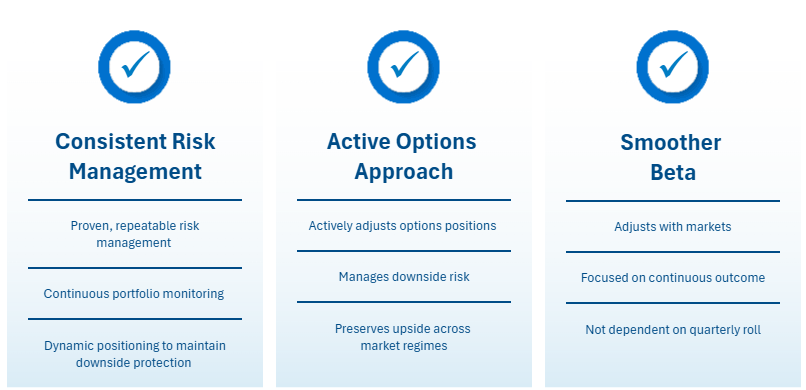
There is no guarantee these objectives will be achieved.
Before investing, carefully consider the fund’s investment objectives, risks, charges and expenses. Please see the prospectus and summary prospectus containing this and other information which can be obtained by calling 1-866-363-9219. Read it carefully before investing.
AUM data as of June 30, 2026.
Beta is a measure of equity sensitivity, where 1.0 equals the beta of the market, in this case, the US equity market, as measured by the S&P 500 Index. Indexes are unmanaged, do not include fees or expenses and are not available for direct investment.
An investment in the Fund(s) is subject to risks, and you could lose money on your investment in the Fund(s). There can be no assurance that the Fund(s) will achieve its investment objective. Your investment in the Fund(s) is not a deposit in a bank and is not insured or guaranteed by the Federal Deposit Insurance Corporation (FDIC) or any other government agency. The risks associated with an investment in the Fund(s) can increase during times of significant market volatility. The Fund(s)
The principal risks of investing in the Calamos Active Hedged Equity ETF include: American depository receipts risk, authorized participant concentration risk, cash holdings risk, costs of buying and selling fund shares, correlation risk, covered call writing risk, currency risk, debt securities risk, interest rate risk, credit risk, default risk, derivatives risk, equity securities risk, FLEX options risk, foreign securities risk, forward foreign currency contract risk, futures and forward contracts risk, liquidity risk, market maker risk, market risk, new fund risk, options risk, other investment companies risk, portfolio selection risk, portfolio turnover risk, premium-discount risk, secondary market trading risk, sector risk, tax risk, trading issues risk, uncovered call writing risk.
Other Investment Companies Risk: The Fund may invest in the securities of other investment companies to the extent that such investments are consistent with the Fund’s investment objectives and permissible under the 1940 Act.
FLEX Options Risk: The Fund will utilize FLEX Options issued and guaranteed for settlement by the Options Clearing Corporation (OCC). In the unlikely event that the OCC becomes insolvent or is otherwise unable to meet its settlement obligations, the Fund(s) could suffer significant losses. Additionally, FLEX Options may be less liquid than standard options. In a less liquid market for the FLEX Options, the Fund(s) may have difficulty closing out certain FLEX Options positions at desired times and prices. The values of FLEX Options do not increase or decrease at the same rate as the reference asset and may vary due to factors other than the price of reference asset. Shares are bought and sold at market price, not net asset value (NAV), and are not individually redeemable from the fund. NAV represents the value of each share’s portion of the fund’s underlying assets and cash at the end of the trading day. Market price returns reflect the midpoint of the bid/ask spread as of the close of trading on the exchange where fund shares are listed.
Calamos Investments LLC, referred to herein Calamos is a financial services company offering such services through its subsidiaries: Calamos Advisors LLC, Calamos Wealth Management LLC, Calamos Investments LLP, and Calamos Financial Services LLC.
NOT FDIC INSURED | MAY LOSE VALUE | NO BANK GUARANTEE